As organizations head into 2026, facilities leaders are operating in a demanding environment shaped by tight budgets and rising expectations for consistency, safety, and occupant experience. Economic pressure remains a defining backdrop: in fact, 81% of facilities management leaders identified cost efficiency and budget optimization as a leading priority for the coming year, according to a recent industry survey. This signals a clear shift away from simple cost cutting toward more strategic approaches—such as streamlined supply chains, risk mitigation, and technology-enabled workflows.
Facilities teams are being asked to deliver more—with fewer resources—while navigating increasing operational complexity. The following five shifts highlight where facilities management is headed—and what will matter most to organizations focused on long-term performance and reliability.
1. Robotics Shift from Novelty to Integrated Solutions
Robotics have clearly moved beyond experimentation. According to one recent survey, 43% of facility leaders plan to purchase robotics or autonomous equipment in the next 12 months, making it the most widely planned technology investment across facilities operations.
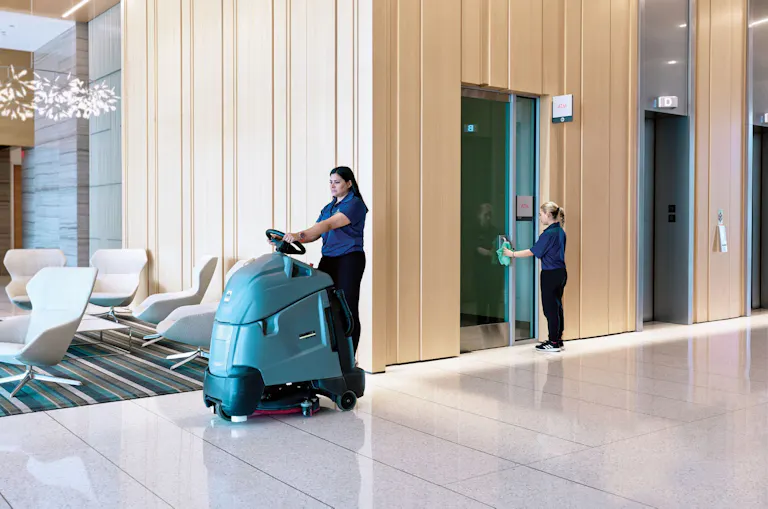
The value is clear in repetitive, labor-intensive tasks—particularly floor care—where consistency and cost control matter most. Fifth-generation robots, developed in part through feedback KBS has provided to several manufacturers, deliver stronger debris collection, fewer manual assists, and more reliable performance. As labor pressure persists, robotics function as true force multipliers, allowing frontline teams to focus on detail work and higher-priority tasks. As deployments expand, leaders are also prioritizing platforms with established security and data governance standards.
With more than 100 years of combined staff robotics expertise, KBS is a leader in integrating autonomous cleaning equipment and smart technologies into holistic, tailored facility programs. So far, KBS crews have used robotics to clean more than 51+ million square feet (or 4,200+ miles) of space for major brands—equivalent to cleaning a path from Chicago to Paris.
2. AI Supports Data-Driven, Day-to-Day Decision-Making
AI adoption in facilities management is still early, but momentum is building. Today, 12% of organizations report partial AI implementation, while 4% report full implementation across building management practices.
The most impactful use cases are emerging onsite. AI is helping facility managers understand space utilization, anticipate demand, and deploy labor more effectively, enabling proactive decisions instead of reactive responses. At KBS, AI-driven tools support earlier account intervention, smarter resource allocation, and stronger client relationships. For example, in one use case, KBS is using AI to analyze client email sentiment, classifying incoming work orders with 25% greater accuracy than keyword-based systems, and powering intelligent summaries that help teams quickly understand and then resolve escalations.
3. Sustainability Becomes Built In, Not Bolted On
Sustainability remains a priority, but its execution is evolving. Seventy percent of facility leaders list sustainability as a top planning priority, but the emphasis is shifting toward practical, integrated approaches that support both efficiency and environmental goals.
This includes continued use of electrical equipment, environmentally safe cleaning systems, and reduced travel footprints. KBS helps clients support sustainability goals through the use of gas-efficient, fleet modernization; battery-operated equipment; proprietary technology, and green-certified chemical cleaning options. This delivers measurable results such as 10% year-over-year reductions in fuel consumption and GHG emissions per vehicle, as well as significantly lower water, energy, and chemical usage.
4. Multifunction Equipment Enables Greater Operational Efficiency
Labor shortages and tight budgets are accelerating demand for equipment that can do more with fewer resources. While multifunction tools have existed for years, today’s systems are far more advanced—combining wet/dry vacuuming, scrubbing, buffing, edging, and high dusting, often with mobile-based training and configuration.
These advancements reduce storage needs, simplify training, and increase productivity per shift. At KBS, our proprietary Multi-Tool Cleaning System consolidates multiple cleaning pieces of cleaning equipment into a single unit—reducing trips to janitor closets, minimizing downtime, and helping crews stay productive throughout their shift. With hundreds of MultiTool systems currently deployed in the field, KBS is enabling consistent, efficient execution at scale.
5. Building Safety Culture into Daily Operations
Safety is no longer viewed as a compliance exercise—it’s a driver of operational excellence. Organizations that invest in effective safety programs see tangible returns, roughly $4 to $6 for every $1 invested, according to the U.S. Department of Energy.
Rather than relying solely on incident response, facilities leaders are embedding safety into daily routines, equipment choices, and work processes. Technology and data reinforce safe behaviors consistently across sites. At KBS, safety starts from the ground up, making sure our crews are properly trained in all safety procedures, including complex operating environments such as distribution and logistics centers. Our new digital Learning Management System (LMS) has driven nearly 1 million total online course enrollments across North America, equipping crews with the knowledge and confidence to work safely, efficiently, and consistently at every site.
Setting the Standard for 2026 and Beyond
Together, these five shifts point to a more integrated and resilient future for facilities management—one defined by smarter use of automation, data-driven decision-making, practical sustainability, safer operations, and tools that help teams do more with less. In 2026, organizations that execute across these areas will be best positioned to deliver consistent performance, even amid economic pressure and resource constraints.
Ready to talk? Our experts are ready to help you build smarter, safer, and more efficient operations for 2026 and beyond.